🔬 Interactive Cell Comparator
Click each cell type to explore its structure. NEET aspirants — pay attention to differences between prokaryotic and eukaryotic cells!
📋 Table of Contents
🎬 Watch the Recorded Lesson
Watch the recorded lecture before starting the lesson.
🔬 Discovery of the Microscope
Section 1 · History of Science · NCERT Chapter 2
The human eye can only see objects above a certain size. Everything changed when people discovered that a curved piece of glass — shaped like a lentil seed, thick in the middle and thin at the edges — could magnify small objects. This curved glass was called a lens.
In 1665, Robert Hooke published Micrographia. Using his microscope (200–300× magnification), he examined cork and saw tiny box-like compartments he named cells — the first use of this word in science. Antonie van Leeuwenhoek built far more powerful microscopes and was the first to see and describe bacteria and blood cells. He is called the "Father of Microbiology".
📖 1665 — Robert Hooke coins the word "cell" in Micrographia
🔬 1670s — Leeuwenhoek sees bacteria and blood cells
🏆 Leeuwenhoek = Father of Microbiology
🧪 Activity 2.1 — Round-Bottom Flask Magnifier
- Fill a round-bottom glass flask completely with water and seal with a cork.
- Place it over an open book — the letters appear larger! The curved water-filled flask acts like a magnifying glass.
- Now use a real magnifying glass to observe an ant — you can see body details much more clearly.
🎯 Types of Microscopes for NEET: The Light Microscope (LM) uses visible light — magnifies up to ~1,500×. Shows cells and large organelles. The Electron Microscope (EM) uses electrons — magnifies up to 10,00,000× (10 lakh times!). Reveals ribosomes, endoplasmic reticulum, membranes. Two types: TEM (internal structure) and SEM (surface structure). NEET frequently asks which organelle was discovered using which microscope!
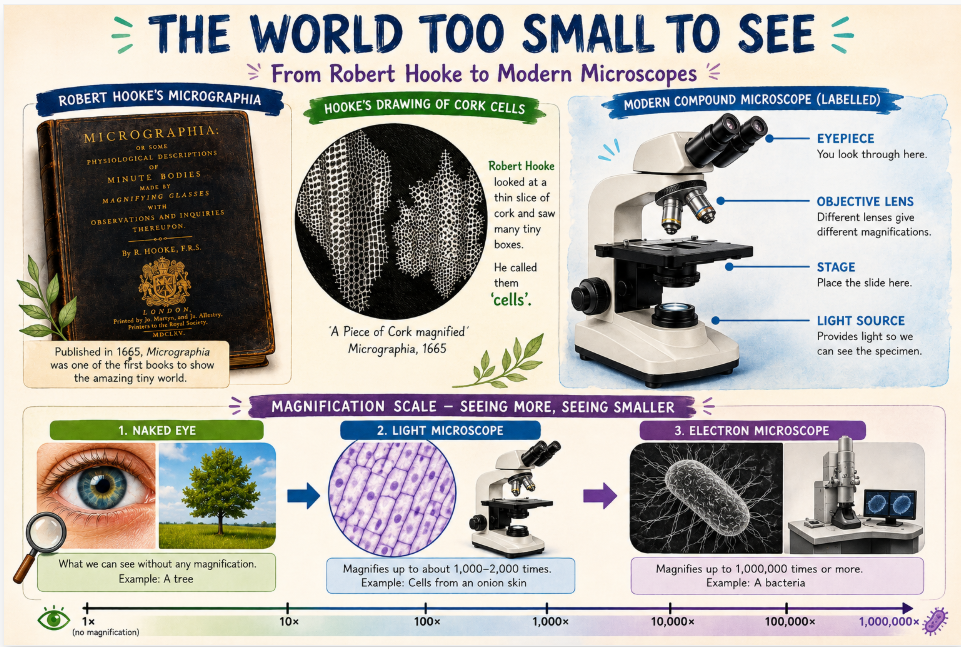
History of the Microscope: Robert Hooke’s Micrographia, cork cell drawing, labelled compound microscope, and magnification comparison from naked eye to electron microscope.
⚡ Quick Check — Section 1
Who coined the term "cell" and what did they use it to describe?
Why is Leeuwenhoek called the "Father of Microbiology"?
🎯 NEET: Which microscope magnifies up to 10 lakh times and is needed to see ribosomes?
🧬 What Is a Cell? — Structure & Parts
Section 2 · Cell Biology · NCERT Chapter 2
All living beings are made of cells. The cell is the basic structural and functional unit of life. Every cell contains three fundamental parts: the cell membrane, the cytoplasm, and the nucleus. Plant cells have an additional outer layer — the cell wall.
In Activity 2.2 (onion peel), you see rectangular cells in a regular lattice — the rigid cell wall gives this shape. In Activity 2.3 (cheek cells), you see polygon-shaped flat cells — animal cells have no cell wall and are flexible.
🔵 Cell membrane — outer boundary; porous; controls what enters/exits
🟡 Cytoplasm — jelly-like fluid; site of most life processes; contains carbohydrates, proteins, fats, mineral salts
🔴 Nucleus — "control centre"; contains DNA; regulates all cell activities and growth
🟩 Cell wall — rigid outer layer (cellulose); provides shape and strength
🌱 Chloroplasts — contain chlorophyll; site of photosynthesis; give green colour
💧 Large central vacuole — stores water, nutrients, waste; maintains cell shape (turgor pressure)
🧪 Activity 2.2 — Onion Peel Practical
- Peel thin inner layer from onion using forceps → stain with safranin (30 sec) → rinse in water.
- Mount on glass slide with glycerin drop → add coverslip at 45° → observe under microscope.
- You see rectangular cells with cell wall, nucleus, and cytoplasm clearly. Glycerin prevents drying; safranin stains cells pink for visibility.
| Feature | Plant Cell | Animal Cell |
|---|---|---|
| Cell wall | ✅ Present (cellulose) | ❌ Absent |
| Cell membrane | ✅ Present | ✅ Present |
| Nucleus | ✅ Present | ✅ Present |
| Chloroplasts | ✅ In green parts | ❌ Absent |
| Vacuole | ✅ Large central vacuole | ❌ Usually absent/very small |
| Shape | Regular, rectangular (rigid) | Irregular, variable (flexible) |
🎯 Cell Shape Relates to Function (NEET Core Concept):
• Spindle-shaped muscle cells → contract and shorten to create movement
• Neurons → long axon + many dendrites → receive from many cells, transmit signals over long distances
• Flat cheek cells (epithelial) → form smooth protective lining
• Biconcave RBCs → max surface area for O₂ transport; no nucleus in humans = more space for haemoglobin
This principle — structure is related to function — is a core NEET concept tested every year!
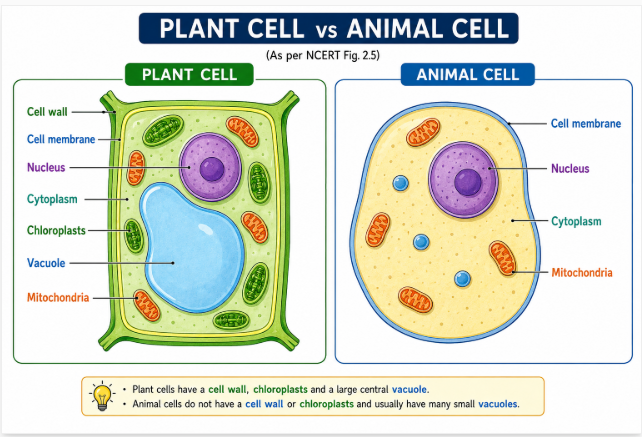
Plant Cell vs Animal Cell: Labelled diagrams showing cell wall, cell membrane, nucleus, cytoplasm, chloroplasts, vacuole, and mitochondria.
⚡ Quick Check — Section 2
Name the three basic parts found in ALL cells.
Give three differences between plant and animal cells.
🎯 NEET: Why is the neuron so long with many branches?
⚗️ Cell Organelles — NEET Foundation
Section 3 · Beyond Class 8 · Explained Simply for NEET
Your NCERT introduces basic cell parts. NEET biology goes deeper — you need to know the organelles inside cytoplasm, what they do, and why. Think of organelles as "tiny organs" inside a cell — just like your body organs have specific jobs, organelles have specific jobs.
| Organelle | Nickname | Function (simple) | Where found? |
|---|---|---|---|
| Mitochondria | Powerhouse | Makes energy (ATP) from food — like a power plant | All eukaryotic cells |
| Chloroplast | Kitchen of plant | Photosynthesis — makes glucose using sunlight | Green plant cells only |
| Ribosome | Protein factory | Makes proteins — like a manufacturing unit | All cells (even bacteria) |
| Vacuole | Storage tank | Stores water, sap, waste; maintains cell shape | Large in plants; tiny/absent in animals |
| Endoplasmic Reticulum | Transport highway | Transports materials; makes lipids (smooth ER) or proteins (rough ER) | Eukaryotic cells |
| Golgi Apparatus | Post office | Sorts, packages, and sends out proteins made by ER | Eukaryotic cells |
| Lysosome | Suicidal bag / Dustbin | Breaks down old/damaged cell parts and foreign particles | Animal cells mainly |
| Nucleus | Control centre | Contains DNA; controls all cell activities and division | All eukaryotic cells |
🎯 MOST IMPORTANT NEET CONCEPT — Prokaryote vs Eukaryote:
Eukaryotic cells (eu = true, karyon = nucleus): have a TRUE nucleus enclosed in a nuclear membrane. Have all membrane-bound organelles. Examples: plant cells, animal cells, fungi, protozoa, algae.
Prokaryotic cells (pro = before, karyon = nucleus): NO true nucleus — DNA floats in a region called the nucleoid with NO nuclear membrane. NO membrane-bound organelles. Have ribosomes but smaller: 70S type (not 80S). Example: Bacteria only.
Viruses = neither (acellular — not cells at all!). This difference comes up in NEET almost every year.
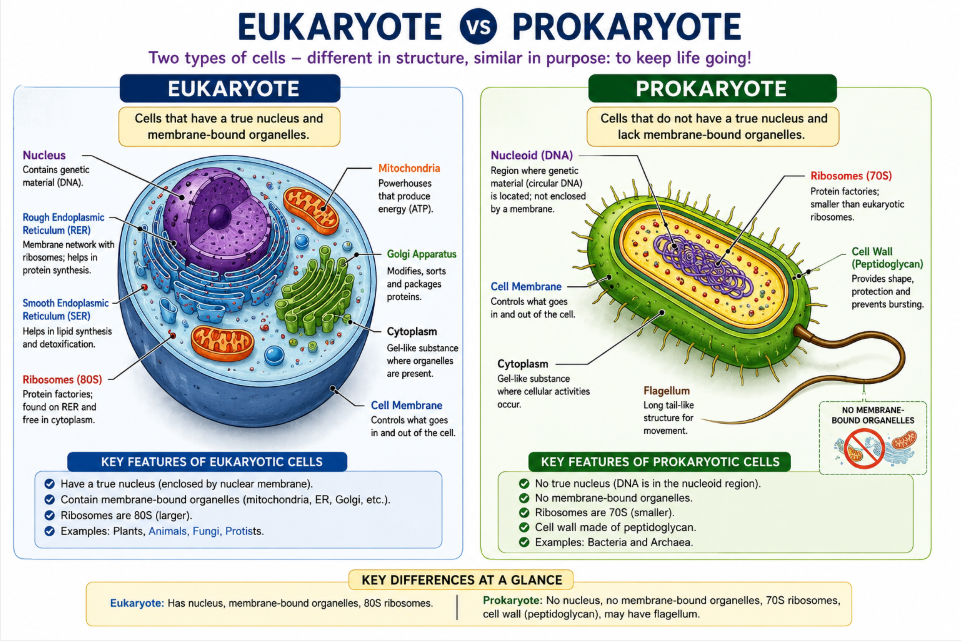
Prokaryotic vs Eukaryotic Cells: Comparison showing nucleus, organelles, ribosomes, nucleoid region, cell wall, and flagellum.
⚡ Quick Check — Section 3
🎯 Why is mitochondria called the "powerhouse of the cell"?
🎯 What is the key difference between prokaryotic and eukaryotic cells?
🎯 Why is the Golgi apparatus called the "post office" of the cell?
🏗️ Levels of Organisation in Living Organisms
Section 4 · Organisation · NCERT Chapter 2
The body of a complex organism is organised hierarchically — from the smallest unit (cell) to the whole organism. Think of it like building a skyscraper: individual bricks → walls → rooms → floors → the complete building.
CELL
Basic unit
TISSUE
Similar cells
ORGAN
Different tissues
ORGAN SYSTEM
Several organs
ORGANISM
Complete being
🦠 Cell → Single muscle cell or secretory cell
🧱 Tissue → Muscle tissue (many muscle cells together)
🫀 Organ → Stomach (muscle + secretory + other tissues)
⚙️ Organ System → Digestive system (mouth, oesophagus, stomach, intestines)
🧍 Organism → Complete human being
All complex organisms begin life as a single cell — the egg, which divides repeatedly to form millions of cells. Organisms made of many cells = multicellular (plants, animals). Fun fact from NCERT: the ostrich egg yolk is the largest single cell in the world — 130–170 mm diameter!
🎯 Four Types of Animal Tissue (NEET Class 9 preview):
(1) Epithelial tissue — covers surfaces and organs (cheek cells, skin)
(2) Connective tissue — connects and supports (blood, bone, cartilage, fat)
(3) Muscle tissue — movement (striated/skeletal, smooth, cardiac)
(4) Nervous tissue — transmits signals (neurons + glial cells)
In plants: Meristematic tissue (dividing cells at tips) and Permanent tissue (xylem for water, phloem for food, epidermis for protection).
⚡ Quick Check — Section 4
Write the correct order of levels of organisation from smallest to largest.
What is the difference between unicellular and multicellular organisms? Give one example of each.
Multicellular: many specialised cells cooperate. Example: humans, plants, mushrooms (multicellular fungi).
🎯 NEET: Name the four types of animal tissue with one example each.
🦠 Microorganisms — The Invisible World
Section 5 · Microbiology · NCERT Chapter 2
Microorganisms (microbes) are organisms too small to be seen with the naked eye. They are found everywhere — water, soil, air, food, inside our bodies, even in hot springs and frozen ice. A microscope (100–400× magnification) is needed to see them.
Bacteria
Prokaryotic. Shapes: spherical (cocci), rod (bacilli), spiral (spirilla). Helpful: Lactobacillus, Rhizobium. Harmful: Salmonella, Vibrio cholerae.
Fungi
Eukaryotic. No chlorophyll — cannot photosynthesise. Cell wall = chitin. Unicellular (yeast) or multicellular (mould, mushroom).
Protozoa
Eukaryotic, unicellular. Move using pseudopodia (Amoeba), cilia (Paramecium), flagella. Some cause diseases: Plasmodium → malaria.
Algae
Eukaryotic. Have chlorophyll — can photosynthesise. Produce 50%+ of Earth's oxygen! Examples: Spirulina (superfood!), Chlorella, Diatoms.
Viruses
Acellular — not cells at all! Only replicate inside a living host. Cause: COVID-19, flu, dengue, polio, rabies. Made of DNA/RNA + protein coat (capsid).
🎯 Virus Structure for NEET:
Viruses consist of: (1) Nucleic acid — either DNA OR RNA (never both). (2) Protein coat (Capsid) — made of capsomers; protects the genetic material. (3) Some have an envelope (lipid membrane stolen from host — e.g. HIV, Influenza, COVID-19). Envelope-less = naked viruses (Polio, Hepatitis A).
They have NO cell membrane, cytoplasm, ribosomes, or organelles. They are NOT cells — they hijack host cell machinery to replicate. This is why they are placed outside the five kingdoms by many scientists.
| Microorganism | Cell Type | Unicellular/Multicellular | Nucleus? | Chlorophyll? |
|---|---|---|---|---|
| Bacteria | Prokaryotic | Unicellular | No (nucleoid) | No |
| Protozoa | Eukaryotic | Unicellular | Yes | Usually No |
| Algae | Eukaryotic | Both | Yes | Yes |
| Fungi | Eukaryotic | Both (yeast=uni) | Yes | No |
| Virus | Acellular | — (not a cell) | No | No |
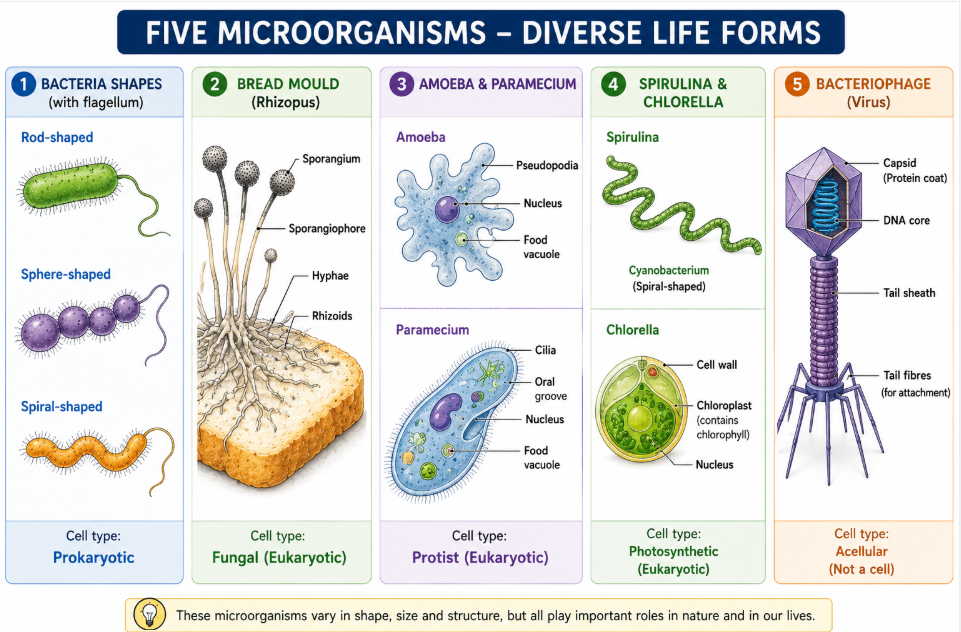
Five Types of Microorganisms: Bacteria, fungi, protozoa, algae, and viruses with labelled structural features.
⚡ Quick Check — Section 5
What is the key difference between a bacterium and a protozoan?
Why are viruses called "acellular"? How are they different from all other microorganisms?
🎯 NEET: Fungi cell walls are made of which substance? How does this differ from plant and bacterial cell walls?
🌿 Microbes & the Environment
Section 6 · Ecology · NCERT Chapter 2
Microorganisms are nature's recyclers — they break down complex organic matter back into simple substances that plants can use again. This process is called decomposition. Fungi and bacteria act on dead organic matter (leaves, dead animals, food waste) and break it down into nutrient-rich manure, which returns to the soil and improves fertility.
🧪 Activity 2.7 — Making Natural Manure (Composting)
- Fill a container halfway with garden soil. Add fruit and vegetable peels. Cover with another soil layer.
- Leave undisturbed for 2–3 weeks.
- Result: peels turn into dark, nutrient-rich manure — caused by soil bacteria and fungi breaking down the organic waste (decomposition)!
🎯 Nitrogen Cycle Introduction (NEET):
The atmosphere is 78% N₂ but plants cannot use it directly. Steps:
(1) Nitrogen fixation: Rhizobium converts N₂ → NH₄⁺ (ammonium) in soil.
(2) Nitrification: Nitrosomonas + Nitrobacter convert NH₄⁺ → nitrites → nitrates (usable by plants).
(3) Plants absorb nitrates → build proteins → eaten by animals.
(4) Decomposition: bacteria + fungi break down dead organisms → nitrogen returned to soil.
(5) Denitrification: some bacteria convert nitrates back to N₂ gas → cycle repeats.
This shows why microbes are absolutely essential for life on Earth!
⚡ Quick Check — Section 6
What is decomposition and why is it important for the environment?
What is Rhizobium and why do farmers grow legumes in crop rotation?
🎯 NEET: Name the two bacteria involved in nitrification and what they convert.
🍞 Microbes & Food — Fermentation
Section 7 · Food Microbiology · NCERT Chapter 2
Many of our favourite foods are made WITH microorganisms through a process called fermentation — where microbes break down sugars and produce useful products like CO₂, alcohol, or lactic acid. This process has been used by humans for thousands of years!
Yeast (a unicellular fungus) is key in bread and cake making. It breaks down sugar anaerobically (without oxygen), releasing CO₂ gas. CO₂ bubbles get trapped in dough, making it rise and become soft and fluffy. A small amount of alcohol is also produced (giving the characteristic smell).
🫙 Lactobacillus → curd (converts lactose → lactic acid → thickens and sours milk)
🧫 Yeast (Saccharomyces cerevisiae) → bread, cake, bhatura (releases CO₂)
🫶 Mixed bacteria → idli/dosa batter (CO₂ + lactic acid = soft texture + tangy flavour)
💊 Penicillium fungus → source of Penicillin antibiotic!
🧪 Activity 2.9 — Curd Formation (Warm vs Cold)
- Bowl A: lukewarm milk + spoonful of curd → keep in WARM place
- Bowl B: cold milk + spoonful of curd → keep in REFRIGERATOR
- Result: Bowl A sets into curd; Bowl B does not.
- Why? Lactobacillus grows best at ~37°C. Cold temperatures inhibit growth → no fermentation → no curd in Bowl B.
🎯 Fermentation Equations for NEET:
Alcoholic fermentation (Yeast — anaerobic):
Glucose → 2 Ethanol + 2 CO₂ + Energy (ATP)
Used in: bread, beer, wine, biofuel production.
Lactic acid fermentation (Lactobacillus):
Glucose → Lactic acid + Energy
Used in: curd, yogurt, cheese, idli, dosa, sauerkraut.
Why don't pickles get infected? High salt/sugar concentration = hypertonic environment. Water moves OUT of microbial cells by osmosis → cells undergo plasmolysis (shrink) and die. Salt and sugar are natural preservatives through this osmotic effect!
| Food Item | Microorganism | Product of Fermentation | Function |
|---|---|---|---|
| Bread / Cakes | Yeast (Saccharomyces) | CO₂ + ethanol | Makes dough rise and fluffy |
| Curd (Dahi) | Lactobacillus | Lactic acid | Thickens milk; makes it sour |
| Idli / Dosa | Mixed bacteria + yeast | CO₂ + lactic acid | Soft texture + tangy flavour |
| Bhatura | Lactobacillus | CO₂ | Makes dough puffy |
⚡ Quick Check — Section 7
What gas does yeast release during fermentation that makes bread dough rise?
Why does curd form in warm milk (Bowl A) but not cold milk (Bowl B)?
🎯 NEET: Why don't microorganisms grow in pickles even though they contain food matter?
🎯 Why is Cell the Basic Unit of Life?
Section 8 · Cell Theory · NCERT + NEET Foundation
The cell is the basic unit of life because every living organism is made of at least one cell. A cell is the smallest structure that can carry out all fundamental life processes — nutrition, respiration, excretion, growth, and reproduction — independently. This is why viruses (which are smaller) are NOT considered fully "alive."
1️⃣ All living organisms are made up of one or more cells.
2️⃣ The cell is the basic structural and functional unit of life.
3️⃣ All cells arise from pre-existing cells (Omnis cellula e cellula — Virchow, 1855).
🎯 Cell Size Facts for NEET:
• Most cells: 1–100 micrometres (μm) in diameter.
• Smallest cell: Mycoplasma (bacterium) — 0.1–0.5 μm. Also the only bacterium without a cell wall!
• Largest cell: Ostrich egg yolk — single cell of 130–170 mm diameter!
• Longest cell: Nerve cell (neuron) of a giraffe — can exceed 1 metre!
• Human body: approximately 37 trillion (3.7 × 10¹³) cells.
• Bacterial cell wall = Peptidoglycan | Plant = Cellulose | Fungi = Chitin
| Feature | Prokaryote (Bacteria) | Eukaryote (Plants/Animals) |
|---|---|---|
| Nucleus | Absent (nucleoid) | True nucleus + nuclear membrane |
| Membrane-bound organelles | Absent | Present (mitochondria, ER, Golgi) |
| Ribosomes | 70S (smaller) | 80S (larger) in cytoplasm |
| Cell wall | Peptidoglycan | Cellulose (plants); absent (animals); chitin (fungi) |
| Size | 0.1–10 μm (smaller) | 10–100 μm (larger) |
| Examples | Bacteria, Cyanobacteria | Amoeba, Yeast, plants, animals |
⚡ Quick Check — Section 8
State Cell Theory in three points.
Name the smallest known cell and the largest known cell.
Largest: Ostrich egg yolk — a single cell (130–170 mm); visible to the naked eye.
🎯 NEET: Why can antibiotics kill bacteria without harming our own cells?
🧠 Multiple Choice Quiz
12 questions — NCERT + NEET Foundation. Purple-bordered = NEET level.
0 of 12 answered
✍️ Long Answer Questions
5 detailed questions — model answers and mark schemes included
⚡ One Word Quiz
20 quick-fire questions — NCERT + NEET Foundation